
Encyclopaedia AethiopicaVolume I
Aksumite culture
- Written by
- Printed in
- Vol. I, pp. 186–188
- Published
- 2003
- Entry
- Article
- Reading
- 4 min
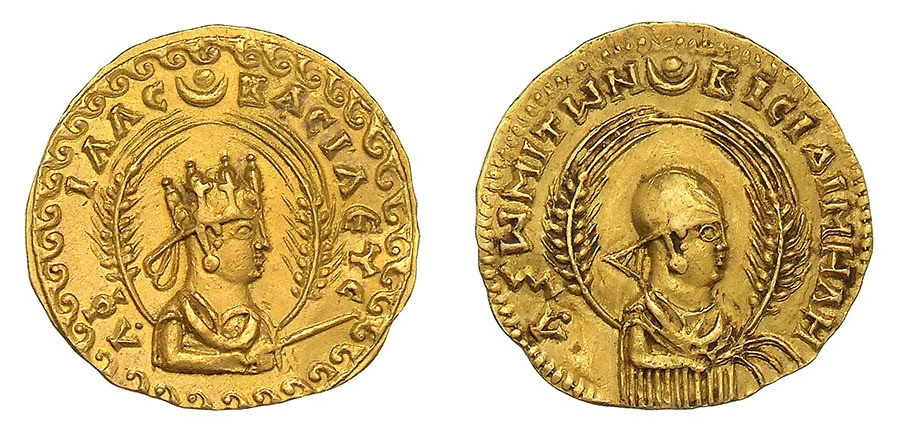
Image source and rights
The Aksumite-culture article explicitly discusses official coinage (printed p. 186). This identified coin of Afilas is an associated example of Aksumite material culture, not a depiction of the entire culture.
Public domain, as recorded on the Wikimedia Commons file page.
View source recordContents
The A.c. period spanned approximately a millennium between ca. 150 B.C. and 900 A.D. and witnessed the development of sociopolitical complexity and state civilization centred in the highlands of northern Ethiopia and Eritrea. The A.c. and its resultant Aksumite State polity (↗Aksum) seem to have developed from preceding sedentary agricultural communities living in the highlands of the northern Horn of Africa during the ↗Proto-Aksumite period (ca. 400–150 B.C.). Archaeological and historical research concerning Aksumite settlement patterns, technology and subsistence economy, suggest that the African origins and foundation of A.c. were paramount in the development of the Aksumite State in the first millennium A.D.
The term “Aksumites” was used as early as the first cent. A.D. in the ↗Periplus of the Erythraean Sea to describe a powerful cultural group of the northern highlands that engaged in international trade and possessed a metropolis. During the 2nd cent. A.D., the geographer of Ptolemy referred to Aksum as a royal capital. Archaeological and textual evidence indicates that by this time a centralized regional polity with defined social stratification had emerged within the A.c. area. By the beginning of the 4th cent. A.D. an Aksumite state with urban centers, official currency in ↗coinage struck in gold, silver and copper, an intensive agricultural system and an organized military (↗Army) was already well established. Between the 4th and 6th cent. A.D. this state functioned as a fully-fledged empire, controlling important ancient trade routes and engaging in expansionistic activity throughout much of the northern ↗Horn of Africa and southern ↗Red Sea area. The early 4th cent. brought the gradual adoption of Christianity throughout the A.c. area. By the 6th cent. A.D. ↗Christianity was firmly established and seems to have helped solidify Aksumite ethnic identity and played a central role in developing and maintaining strategic alliances with the Roman and ↗Byzantine empires. The 7th cent. saw the decline of the Aksumite state as a regional power in north-eastern Africa and the Indian Ocean world. The polity’s final demise during the late first millennium A.D. was, in large part, the result of environmental degradation from over-exploitation of resources and changes in international trading patterns in the Red Sea area and north-eastern Africa subsequent to Islamic expansion.
A.c. settlements were located throughout much of the highlands of the northern Horn of Africa, with the bulk of settlements situated in north-eastern and north-western ↗Tǝgray, Ethiopia and the ↗Akkälä Guzay and ↗Säraye regions of highland Eritrea. However, some Aksumite settlements were also located south of the ↗Täkkäze River and extended as far north as the ↗Rora region of northern Eritrea. In addition to the highlands, A.c. period sites were located along the Red Sea coast of Eritrea near the Gulf of ↗Zula. Many Aksumite settlements were positioned along an axis stretching from Aksum to the Gulf of Zula, following a route linking the Aksumite capital in the highlands to the chief Aksumite port of ↗Adulis and adjacent harbour on the Red Sea. Two of the largest Aksumite-era settlements, ↗Mäṭära and ↗Qoḥayto, were situated in the Eritrean highlands along this route. A concentration of Aksumite settlements existed also along traditional routes connecting the highlands with the western lowlands of the Horn and the eastern Sudan. Expansive residential areas of commoner, middle-rank, and elite occupation were constructed in Aksumite settlements, creating distinctly Aksumite urban landscapes with diversity in function and form. Aksumite urban centres such as those at Aksum, Qoḥayto, and Mäṭära were linked to urban hinterlands, producing extensive areas of ancient settlement and great population density in the highlands of Tǝgray and central Eritrea.
The A.c. possessed sophisticated technologies and craft specializations, including metal-working, diversified ceramic (↗Pottery) and lithic tool traditions, ivory-carving and wood-working industries and elaborate architectural and building traditions. Aksumite ↗architecture and building included the construction of multi-story structures with dressed-stone elements, architectural and agricultural terraces and platforms, complex shaft- and multi-chamber tombs and monumental stone ↗stelae. The capital of Aksum contained hundreds of stone stelae, including three famous giant monoliths elaborately carved as representations of multi-story buildings and very likely marking royal graves of Aksumite rulers.
A complex agricultural system that included irrigation and dam construction, terracing, and plough-farming produced food that sustained urban and rural Aksumite populations and allowed for demographic complexity in the A.c. area. Cereal crops of both African and Near Eastern origin were cultivated by Aksumite farmers, including ↗ṭef (Eragrostis tef), finger-millet (Eleusine coracana), ↗sorghum (Sorghum bicolor), emmer wheat (Triticum dicoccon), bread wheat (Triticum aestivum), hulled ↗barley (Hordeum vulgare) and oat (Avena sp.). Linseed/flax (Linum usitatissimum), ↗cotton (Gossypium sp.), grape (Vitis vinifera) and legumes of Near Eastern origin were grown, including lentil (Lens culinaris), fava bean (Vicia faba), chick-pea (Cicer arietinum), common pea (Pisum sativum) and grass pea (Lathyrus sativus). In addition, domesticates such as the African oil crop, noog (Guizotia abyssinica), as well as gourd (Lagenaria sp.) and cress (Lepidium sativum) represent other important crops grown by the Aksumites. These crops were combined with the herding of domesticated cattle, sheep and goats to create a highly productive indigenous agropastoral food-producing tradition that formed an integral component for the development of the Aksumite economy and state power.
Fine oval globular pot, Fine Red Aksumite ware, bur- nished, rim diameter: 7.2 cm, height: 27.8 cm, diameter at girth: 34.5 cm, from Munro-Hay 1999:184
Sources and literature
Lit.: FRANCIS ANFRAY, Les anciens Ethiopiens: siècles d’histoire, Paris 1990; KATHRYN A. BARD et. al., “The Environmental History of Tigray (Northern Ethiopia) in the Middle and Late Holocene: a Preliminary Outline”, African Archaeological Review 17, 2000, 65–86; SHEILA BOARDMAN, “The Agricultural Foundation of the Aksumite Empire, Ethiopia: an Interim Report”, in: MARIJKE VAN DER VEEN (ed.), The Exploitation of Plant Resources in Ancient Africa, New York 1999, 137–47; ANGELA CATHERINE D’ANDREA et. al., “Ethnoarchaeological Approaches to the Study of Prehistoric Agriculture in the Highlands of Ethiopia”, in: ibid. 101– 22; KARL WILHELM BUTZER, “The Rise and Fall of Axum, Ethiopia: a Geo-Archaeological Interpretation”, American Antiquity 46, 1981, 471–95; CHESTER CAIN, “Results from Zooarchaeological Analysis at Axum, Ethiopia”, Archaeozoologia 10, 1–2, 1999, 27–45; RODOLFO FATTOVICH – KATHRYN A. BARD, “The I.U.O./B.U. Excavations at Bieta Giyorgis (Aksum) in Tigray (Northern Ethiopia)”, JES 30, 1, 1997, 1–29; ID., The Aksum Archaeological Area: a Preliminary Assessment, Napoli 2000; YURI M. KOBISHCHANOV, Axum, tr. by LORRAINE T. KAPITANOFF, ed. by JOSEPH W. MICHELS, University Park 1979; JOSEPH W. MICHELS, “Regional Political Organization in the Axum-Yeha area during the Pre-Axumite and Axumite Eras”, in: PICES 10, vol. 1, 61–80; STUART C. MUNRO-HAY, Aksum: an African Civilisation of Late Antiquity, Edinburgh 1991; DAVID W. PHILLIPSON, Ancient Ethiopia: Aksum, its Antecedents and Successors, London 1998; ID., Archaeology at Aksum, Ethiopia, 1993–7, London 2000; SERGEW HABLE SELLASSIE, Ancient and Medieval Ethiopian History to 1270, Addis Ababa 1972; DAE. Ill.: STUART MUNRO-HAY, “Aksumite Pottery from Medebai”, Aethiopica 2, 1999, 183–89.
Matthew C. Curtis
Cite this entry
Matthew C. Curtis, “Aksumite culture”, Encyclopaedia Aethiopica, Volume I: A–C (2003), pp. 186–188.
Matthew C. Curtis. “Aksumite culture.” In Encyclopaedia Aethiopica, vol. 1, A–C, edited by Siegbert Uhlig, 186–188. Wiesbaden: Harrassowitz Verlag, 2003. https://www.habeshahistory.com/encyclopedia/aksumite-culture-p0216-b-y0352.
Matthew C. Curtis. “Aksumite culture.” Encyclopaedia Aethiopica, edited by Siegbert Uhlig, vol. 1, Harrassowitz Verlag, 2003, pp. 186–188. www.habeshahistory.com/encyclopedia/aksumite-culture-p0216-b-y0352.
Matthew C. Curtis. (2003). Aksumite culture. In Siegbert Uhlig (Ed.), Encyclopaedia Aethiopica (Vol. 1, pp. 186–188). Harrassowitz Verlag. https://www.habeshahistory.com/encyclopedia/aksumite-culture-p0216-b-y0352
- Editor
- Siegbert Uhlig
- Publisher
- Harrassowitz Verlag
- Columns
- 186b, 187a, 187b, 188a