
Encyclopaedia AethiopicaVolume I
Aratu
- Written by
- Printed in
- Vol. I, pp. 312–313
- Published
- 2003
- Entry
- Article
- Reading
- 1 min
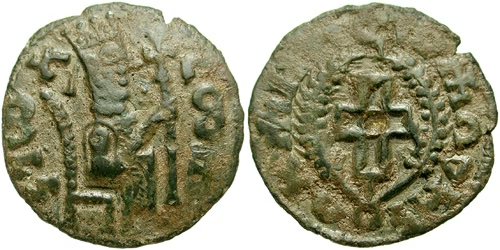
Image source and rights
Contextual relationship only, not a direct depiction of the entry subject. Entry evidence: Aksumite coins of kings Ouazebas (late 4th cent.) and ↗Armaḥ (early 7th cent.) were also collected here. Original source identification: Coin of the Aksumite king Armah; photograph supplied by Classical Numismatic Group.
CC BY-SA 3.0, as recorded on the Wikimedia Commons file page.
View source recordContents
A. (አራቱ) is an archaeological site in Eritrea near ↗Ḥalḥal (15°93'N, 38°28'), 2.5hours from Kärän on the road to Naqfa. A. is so far the northernmost excavated Aksumite site, amidst an extended area of ruins (probably several km²). The main buildings are situated near the top of a natural hill. Investigations were conducted at A. in 1907, by the Italian official Abele Piva.
A. is an urban site with evidence of buildings and plenty of ↗pottery in Aksumite style, mostly red wares with dark core and sherds of light coloured amphorae. Investigations by Piva brought to the light the remains of a large Aksumite building on a stepped podium in the area named “the Bed of Samaratchon”. The platform of the main building consists of 5 large and 2 smaller well worked slabs of granite-like stone, one slab dislocated; some of the slabs have a small raised rim. The building included a squared room with three “altars” in local granite ranging between 2.05m x 1.20 m and 2.10 m x 1.56m in size. Below the eastern edge of the platform a small opening leads to an underground room, which is spanned by a vault made of two layers of burnt bricks (bricks size ca. 22 x 22 x 6,5 cm). In front of this structure a courtyard with small drainage channels has also been recorded. Two stone outlets lie in dislocated position near the building, a third one appears to be still in situ on the north side of the building.
Aksumite coins of kings Ouazebas (late 4th cent.) and ↗Armaḥ (early 7th cent.) were also collected here.
Sources and literature
Lit.: GIOTTO DAINELLI – OLINTO MARINELLI, Risultati scientifici di un viaggio nella Colonia Eritrea, Firenze 1912, passim; ERIC GODET, “Répertoire des sites pré-axoumites et axoumites d’Ethiopie du nord. IIème partie: Erythrée”, Abbay 11, 1980–82, 73–113; ABELE PIVA, “Una civiltà scomparsa dell’Eritrea e gli scavi archeologici nella regione di Cheren”, Nuova Antologia ser. 3, 16, 1907, 323–35.
Rodolfo Fattovich
Source pages

Image source and rights
p. 312
Siegbert Uhlig (ed.), Encyclopaedia Aethiopica, Volume I: A–C. Wiesbaden: Harrassowitz Verlag, 2003.
Facsimile of the entry’s opening in the original publication; a reference image, not a separate subject illustration.
Cite this entry
Rodolfo Fattovich, “Aratu”, Encyclopaedia Aethiopica, Volume I: A–C (2003), pp. 312–313.
Rodolfo Fattovich. “Aratu.” In Encyclopaedia Aethiopica, vol. 1, A–C, edited by Siegbert Uhlig, 312–313. Wiesbaden: Harrassowitz Verlag, 2003. https://www.habeshahistory.com/encyclopedia/aratu-p0342-b-y0352.
Rodolfo Fattovich. “Aratu.” Encyclopaedia Aethiopica, edited by Siegbert Uhlig, vol. 1, Harrassowitz Verlag, 2003, pp. 312–313. www.habeshahistory.com/encyclopedia/aratu-p0342-b-y0352.
Rodolfo Fattovich. (2003). Aratu. In Siegbert Uhlig (Ed.), Encyclopaedia Aethiopica (Vol. 1, pp. 312–313). Harrassowitz Verlag. https://www.habeshahistory.com/encyclopedia/aratu-p0342-b-y0352
- Editor
- Siegbert Uhlig
- Publisher
- Harrassowitz Verlag
- Columns
- 312b, 313a