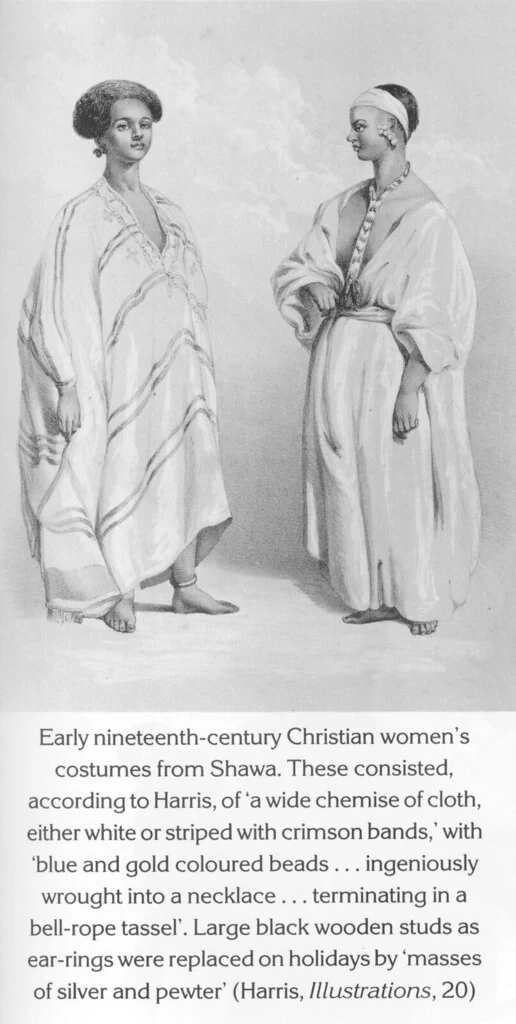
Early nineteenth-century Christian women’s costumes from Shawa. These consisted, according to Harris, of ‘a wide chemise of cloth, either white or striped with crimson bands,’ with ‘blue and gold coloured beads . . . ingeniously wrought into a necklace . . . terminating in a bell-rope tassel’. Large black wooden studs as ear-rings were replaced on holidays by ‘masses of silver and pewter’ (Harris, Illustrations, 20)
Source record
- Date of image
- 19th century
- Source
- Ethiopia Engraved / Link Ethiopia — Habesha History corpus
- Source reference
- Harris, Illustrations, 20
Creator not recorded.
Locality is taken from the source caption, with source spelling retained. Regional and area facets are only supplied for an unambiguous named locality; routes, nearby landmarks, portraits and biographical place references are not assigned to a town.
View the original source record
Image rights
Ethiopia Engraved / Link Ethiopia (CC BY-NC-ND)
User reports permission to use images in the local Habesha History corpus. Original source rights and credits retained; this is not an invented open licence.
Request image removal