DʿMT & early highlandsMG 3
Wʿrn’s altar to Almaqah
Early 1st millennium–5th/4th c. BCEMäqabər Gaʿəwa, Ethiopia
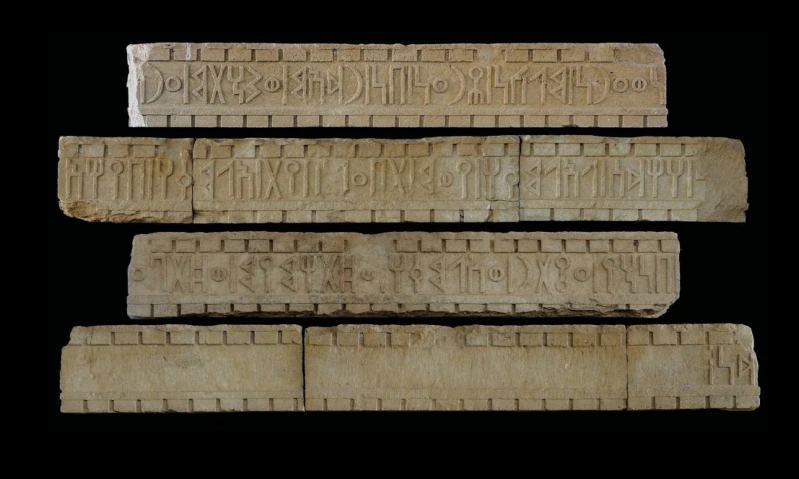
An in-situ altar calls Wʿrn the victorious king, son of Rdʾm, and records his leadership of the temple at Yeha, but never names DʿMT.
Early Sabaic
Surviving text𐩥𐩲𐩧𐩬 𐩣𐩡𐩫𐩬 𐩮𐩧𐩲𐩬 𐩨𐩬 𐩧𐩵𐩱𐩣 𐩥𐩦𐩭𐩩𐩣 𐩲𐩧𐩫𐩺𐩩𐩬 𐩠𐩢𐩵𐩪 𐩡𐩱𐩡𐩣𐩤𐩠 𐩺𐩥𐩣 𐩩𐩨𐩲𐩡 𐩨𐩺𐩩 𐩱𐩡𐩣𐩤𐩠 𐩨𐩺𐩢𐩱 𐩨𐩬𐩭𐩺 𐩲𐩻𐩩𐩧 𐩥𐩱𐩡𐩣𐩤𐩠 𐩥𐩹𐩩𐩢𐩣𐩺𐩣 𐩥𐩹𐩩𐩨𐩲𐩵𐩬
Normalized script from the cited reading; brackets mark restored or missing text.
Transliteration
Wʿrn mlkn ṣrʿn bn Rdʾm w-S²ḫtm ʿrkytn hḥds¹ l-ʾlmqh ywm tbʿl byt ʾlmqh b-Yḥʾ b-nḫy ʿṯtr w-ʾlmqh w-ḏt-Ḥmym w-ḏt-Bʿdn
English translation
Waʿrān, the victorious king, son of Rdʾm and S²ḫtm his female companion, rebuilt the altar for Almaqah when he took charge of Almaqah's temple at Yeha, acting under the guidance of ʿAthtar, Almaqah, Dhāt Ḥamīn and Dhāt Baʿdān.
English rendering after Wolf, Nowotnick and Büchner, The Almaqah Temple of Wukro in Tigrai/Ethiopia (2015), p. 24.
Compare translation
Wʿrn, the victorious king, son of Rdʾm and S²ḫtm the wife, restored the altar for ʾlmqh when he became chief of the temple of ʾlmqh at Yeha, with the guidance of ʿṯtr, ʾlmqh, ḏt-Ḥmym and ḏt-Bʿdn.
DASI CSAI English translation, joined across its single inscribed line; data CC BY 4.0
Sources & references
- MG 3 / DAI ʿAddi ʾAkawǝḥ 2008-1 / DASI 7373
Giulia Buono, ‘MG 3 DAI ʿAddi ʾAkawǝḥ 2008-1’, DASI, first published 2015-01-05
Habesha History corpus
Norbert Nebes, Die Inschriften aus dem ʾAlmaqah-Tempel (2010), p. 231
Fabienne Dugast and Iwona Gajda (2012), p. 11
Wolf, Nowotnick and Büchner, The Almaqah Temple of Wukro in Tigrai/Ethiopia (2015), p. 24.