Aksumite eraRIÉ 180
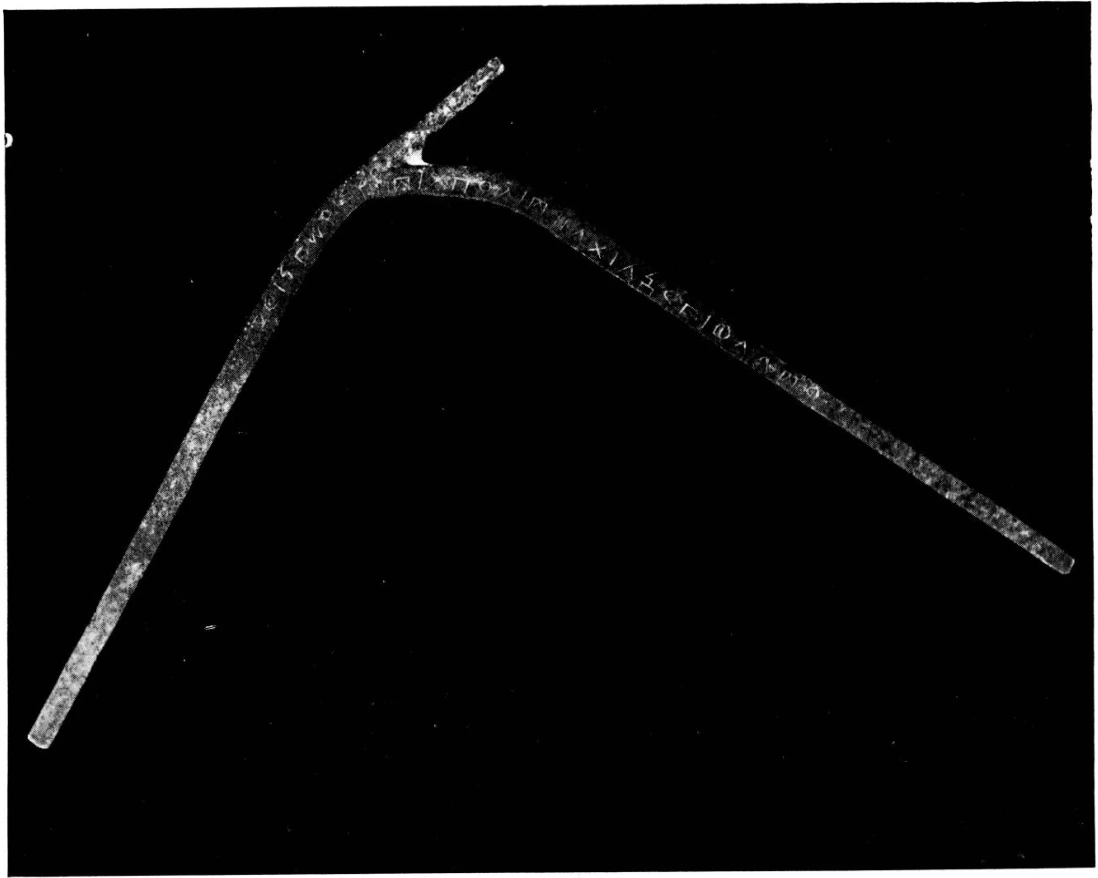
GDR’s inscribed bronze royal object
late 2nd–early 3rd century CEAddi Gelemo, Ethiopia
This complete seven-word Geʿez text on a curved bronze object gives GDR the short title ‘king of Aksum’ and is commonly treated as the earliest surviving indigenous royal inscription of the Aksumite period.
Geʿez
Complete textገደረ ነገሠየ አከሰመ ተበዐለ መዘለተ ለአረገ ወለለመቀ
Normalized first-order Ethiopic from the consonantal reading; the image preserves the early unvocalized letterforms.
Transliteration
gdr ngśy ʾksm tbʿl mzlt lʾrg wllmq
English translation
GDR, king of Aksum: may his sceptre (?) exercise dominion over ʾRG and LMQ.
English rendering of Drewes’s French translation, Recueil des inscriptions de l’Éthiopie III/B (2019), p. 155.
The first three words and royal title are secure, while tbʿl, mzlt, ʾRG and LMQ remain disputed. Nebes (2010, p. 223) instead understands the object as a sceptre handed to GDR by ʾRG and LMQ; the display follows Drewes’s 2019 corpus interpretation and retains his question mark.
Sources & references
- RIÉ 180
Étienne Bernand, Abraham J. Drewes and Roger Schneider, Recueil des inscriptions de l’Éthiopie des périodes pré-axoumite et axoumite, I (1991), pp. 219–220; Abraham J. Drewes, III.B (2019), p. 155.; CC BY-SA 4.0 for the Beta maṣāḥǝft TEI catalogue record
- Further reference
Norbert Nebes, ‘Die Inschriften aus dem ʾAlmaqah-Tempel in ʿAddi ʾAkawəḥ (Tigray)’, Zeitschrift für Orient-Archäologie 3 (2010), p. 223 and n. 51
- Further reference
Fabienne Dugast and Iwona Gajda, ‘Reconsidering contacts between southern Arabia and the highlands of Tigrai in the 1st millennium BC’ (2012 conference paper; HAL deposit 2015), p. 13
- Further reference
André Caquot and Abraham J. Drewes, ‘Les monuments recueillis à Maqallé (Tigré)’, Annales d’Éthiopie 1 (1955), pp. 17–41 and plate XIII
Habesha History corpus
Abraham J. Drewes, Recueil des inscriptions de l’Éthiopie III.B, p. 155–160